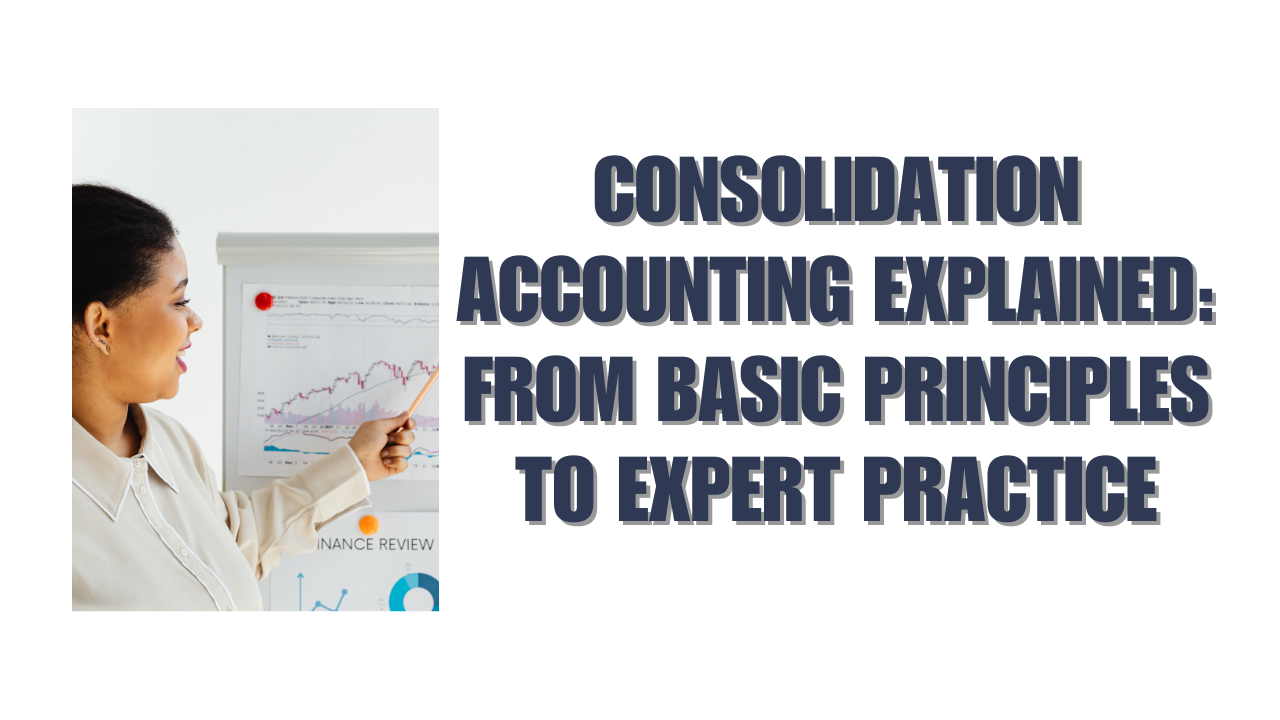
Consolidation accounting represents the process that unites financial statements from multiple entities into a single, complete set of financial statements. A parent company must use consolidation accounting to present the group’s financial performance as one economic unit if it owns more than 50% of another entity.
Financial accounting professionals unite assets and financial items of multiple entities under one umbrella. This streamlined approach helps decision-makers clearly understand their company’s overall performance. The true financial position of complex business structures becomes crystal clear through consolidation accounting.
Let me walk you through a complete guide to the fundamental principles of consolidation accounting. You’ll learn when GAAP and IFRS require it and the practical steps to create consolidated financial statements. On top of that, you’ll master complex calculations and consolidation adjustments, including intercompany reconciliation and transaction elimination.
What Is Consolidation in Accounting and Why It Matters
Modern corporate financial reporting revolves around consolidation accounting. Financial accounting consolidation combines a parent company’s financial statements with its subsidiaries into one integrated set of financial statements. This combined representation shows the financial position, operations results, and cash flows of the group as one economic entity.
Definition of consolidation in financial accounting
Stakeholders need a complete view of a corporate group’s financial health through consolidation. A parent company controls its subsidiaries by owning more than 50% of voting shares or through other control means. Subsidiaries stay separate legal entities with their own financial statements, unlike company divisions. All the same, the parent company presents all controlled entities as one economic unit through consolidation.
Difference between individual and consolidated financial statements
Individual financial statements show one entity’s financial position, while consolidated statements give a comprehensive view of the parent company and its subsidiaries together. Consolidated financial statements contain the same elements as individual reports (balance sheet, income statement, cash flow statement) and present combined figures.
But there’s an important difference: consolidated reports are nowhere near a simple sum of individual statements. The consolidation process requires removing transactions between group members – known as intercompany transactions. This step prevents double-counting of assets, liabilities, revenues, and expenses. To name just one example, when a parent company lends money to its subsidiary, this transaction appears on both entities’ individual statements but must be removed from consolidated reports.
When is consolidation required under GAAP and IFRS
GAAP and IFRS require consolidation when a parent company has a controlling interest in another entity. Companies must consolidate once they hold more than 50% ownership in another entity.
IFRS 10 defines control as an investor having power over an investee, exposure to variable returns, and knowing how to use that power to affect those returns. GAAP employs two main models: the voting interest model and the Variable Interest Entity (VIE) model. The voting interest model needs consolidation with ownership exceeding 50% of voting shares, while the VIE model looks at both power and economic interest.
Companies with between 20% and 50% ownership generally use the equity method of accounting, while those with less than 20% ownership typically use cost accounting. These thresholds help ensure proper financial representation based on a parent company’s influence over its investments.
Types of Consolidation Methods Based on Ownership and Control
Ownership percentage plays a decisive role in choosing the right consolidation method for financial accounting. Companies need to pick the most suitable method based on their control level over another entity. Each method shows a unique relationship between the investor and investee.
Full consolidation for >50% ownership
Full consolidation applies when a parent company owns more than 50% of another entity’s voting rights and gains controlling interest. The parent company’s financial statements combine 100% of the subsidiary’s assets, liabilities, revenues, and expenses. Companies must remove all intercompany transactions to avoid double-counting. The balance sheet and income statement need to show the non-controlling interest (NCI) separately, which represents minority shareholders’ claims. This method shows the real-life situation where the parent has complete control over the subsidiary’s operations and financial policies.
Equity method for 20%-50% ownership
The equity method becomes relevant when an investor holds between 20% and 50% of another entity’s voting stock. This range usually points to significant influence rather than control. The investment shows up as a single line item on the balance sheet at cost. The investor then adjusts this value to match its share of the investee’s earnings or losses. Dividends received lower the investment’s carrying value instead of counting as income. This method acknowledges the investor’s ability to influence financial and operating decisions without having complete control.
Proportionate consolidation in joint operations
Current accounting standards have largely moved away from proportionate consolidation, but it still applies in specific cases. This method used to add a portion of the investee’s assets, liabilities, revenues, and expenses to the parent’s financial statements based on ownership percentage. IFRS stopped allowing proportionate consolidation for joint ventures in 2013, requiring the equity method instead. Now, this approach works only for joint operations where parties have specific asset rights or liability obligations.
When to use each method under GAAP vs IFRS
GAAP and IFRS both require full consolidation when control exists (typically >50% ownership). Their assessment methods differ though. GAAP uses two models: the Variable Interest Entity (VIE) model and the voting interest model. IFRS takes a simpler approach with a single control-based model under IFRS 10. Both frameworks require the equity method for significant influence (20-50% ownership). IFRS looks at potential voting rights when evaluating significant influence, while GAAP doesn’t. IFRS also lets companies with joint operations recognize specific assets and liabilities proportionally based on contractual rights rather than ownership percentage.
Rules and Standards Governing Consolidation Accounting
Regulatory frameworks serve as the foundation for combining accounting practices in markets worldwide. Companies follow two main standards in this area: ASC 810 for US GAAP and IFRS 10 for international coverage.
ASC 810 and the voting interest vs VIE model
US GAAP’s ASC 810 sets up two different ways to combine accounts. The voting interest model requires companies to combine accounts when a parent owns more than 50% of voting shares or has majority kick-out rights in partnerships. The Variable Interest Entity (VIE) model comes into play when control exists through contracts instead of voting rights. Companies must combine VIE accounts when they control important activities and face possible major returns.
IFRS 10: Control, power, and variable returns
IFRS 10 uses one control-based model that works for companies of all types. Control happens when investors have power over their investment, exposure to changing returns, and know how to influence those returns through their power. This three-part definition looks at what really matters, not just the paperwork. It shows that power often goes beyond just voting rights.
Treatment of non-controlling interest (NCI)
Non-controlling interest shows the subsidiary’s equity that doesn’t belong to the parent. IFRS says companies must show NCI as part of equity on the consolidated balance sheet, but separate from the parent’s equity. Companies can measure NCI in two ways: at fair value or as a share of identifiable net assets that matches their ownership.
Elimination of intercompany transactions
Companies need to remove transactions between group members to show the group as one unit. This step prevents counting the same business activity twice. Companies remove internal sales, loans, interest payments, and profits not yet realized from inventory transfers.
Currency conversion and reporting period alignment
Companies that combine accounts with different currencies need to translate them. They usually convert balance sheets at current rates and income statements at average rates. After the first combination at specific exchange rates, they might need to revalue when rates change. These translation differences usually end up in other comprehensive income.
Step-by-Step Breakdown of the Consolidation Process
The process of uniting companies requires careful execution through several well-defined stages. Companies must pay attention to detail and strictly follow accounting standards to create accurate consolidated financial statements.
Identifying entities to consolidate
Companies must first determine which entities need consolidation. GAAP mandates consolidation when a company controls another through majority voting interest (over 50%) or through the Variable Interest Entity model. IFRS requires consolidation when an investor possesses power over an investee, exposure to variable returns, and knows how to affect those returns.
Gathering and aligning financial statements
After identifying entities, companies should collect complete financial information that includes trial balances, statements, and supporting schedules for intercompany transactions. All entities should follow consistent accounting policies. Subsidiaries using different methods for depreciation or revenue recognition will need adjustments.
Adjustments for intercompany transactions
Intercompany eliminations are the foundations of consolidation. These adjustments remove internal transactions to avoid double-counting. Companies typically eliminate intercompany sales and purchases, receivables and payables, dividends, profit in inventory, and loans with related interest.
Calculating and presenting NCI
Non-controlling interest shows a subsidiary’s equity not attributable to the parent. IFRS defines NCI as “the equity in a subsidiary not attributable, directly or indirectly, to a parent”. The original measurement influences goodwill calculation and subsequent accounting. IFRS allows NCI measurement either at fair value (full goodwill model) or proportionate interest in net assets.
Recording goodwill and fair value adjustments
Goodwill results from the difference between purchase price and the fair value of identifiable net assets acquired. Companies must assess the subsidiary’s assets and liabilities’ fair value before consolidation. This assessment recognizes previously unrecognized assets and adjusts carrying values to fair value. These adjustments influence goodwill calculation and future depreciation expenses.
Assembling consolidated financial statements
The final stage combines adjusted balances into properly formatted financial statements. Companies prepare the consolidated balance sheet, income statement, cash flow statement, and statement of changes in equity with appropriate classifications. Verification ensures compliance with applicable accounting standards and includes necessary disclosures about consolidation policies.
Conclusion
We’ve explored the complex world of consolidation accounting and its vital role in financial reporting. Without doubt, consolidation accounting forms the foundation to present accurate financial data in complex corporate structures. It reshapes separate financial statements into one clear picture of economic reality. This helps stakeholders make smart decisions based on an organization’s true financial position.
The choice of consolidation method depends on ownership percentages. Companies need full consolidation with controlling interest above 50%. The equity method applies when there’s major influence between 20-50%. On top of that, companies must follow different rules based on their location – ASC 810 for US GAAP users and IFRS 10 for international coverage.
The biggest challenge in consolidation accounting lies in paying close attention at each step. Companies need to identify which entities to combine and remove intercompany transactions with precision. This prevents any misrepresentation of financial data. Non-controlling interests and goodwill calculations add more layers of complexity, so a deep grasp of relevant standards is crucial.
Financial experts must stay alert to currency conversion issues when working with multinational entities. Matching reporting periods and accounting policies will give consistent consolidated statements.
Becoming skilled at consolidation accounting takes time and expertise. The transparency it brings to financial reporting makes it worth the effort. Business structures keep getting more complex, and knowing how to present clear, consolidated financial data becomes vital for investors, regulators, and managers. This detailed guide gives you the basic knowledge to direct your way through consolidation accounting’s intricate world.
FAQs
Q1. What is consolidation accounting and why is it important?
Consolidation accounting is the process of combining financial statements from multiple entities into a single set of financial statements. It’s important because it provides a comprehensive view of a corporate group’s financial health, treating the parent company and its subsidiaries as one economic unit.
Q2. When is consolidation accounting required?
Consolidation accounting is typically required when a parent company owns more than 50% of another entity’s voting rights, establishing a controlling interest. Both GAAP and IFRS mandate consolidation in such cases.
Q3. How are intercompany transactions handled in consolidation accounting?
Intercompany transactions, such as sales, loans, and interest payments between group members, must be eliminated during the consolidation process. This prevents double-counting of assets, liabilities, revenues, and expenses in the consolidated financial statements.
Content Overview
About the Author: Jonathan Maharaj

Join The Financial Freedom Newsletter
Join Jonathan Maharaj’s Financial Freedom Newsletter and receive practical insights on wealth building, tax strategy, retirement planning, and long-term financial success. Designed for professionals, business owners, and investors who want to make smarter financial decisions.