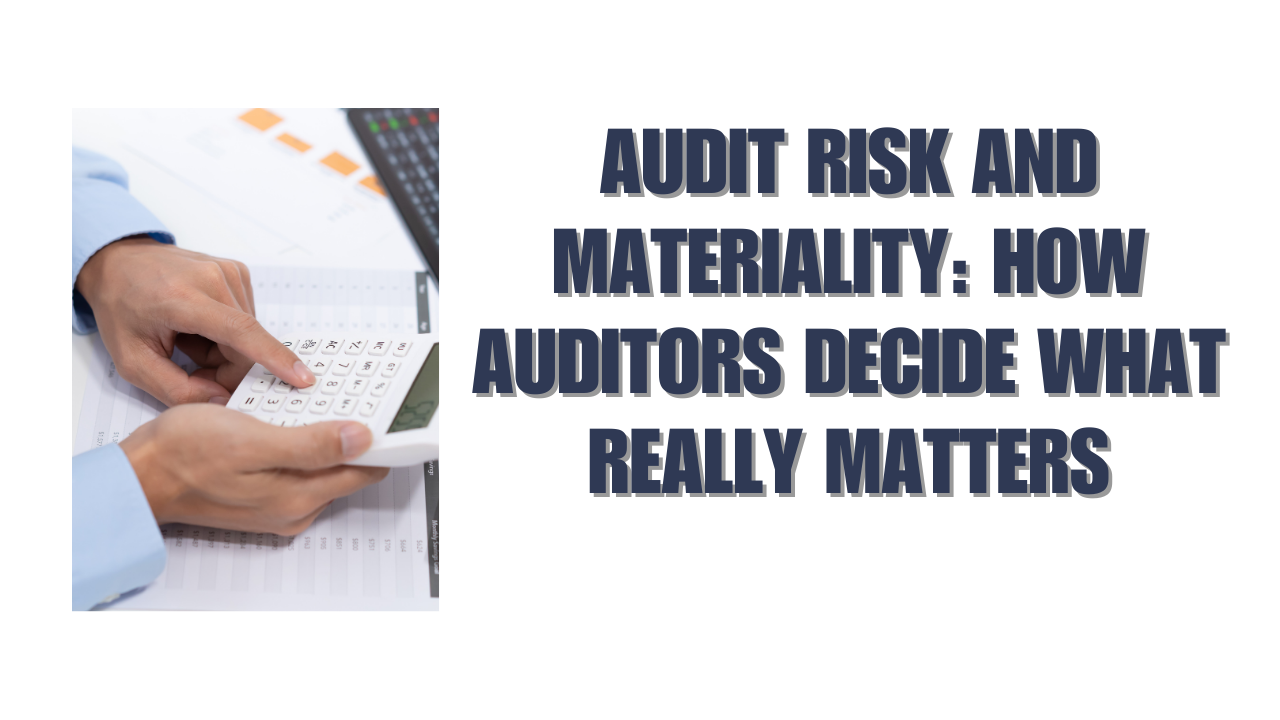
Before an auditor tests a single transaction or reviews a single balance, two foundational concepts shape every decision that follows: audit risk and materiality. These are not abstract academic ideas. They are practical tools auditors use to decide where to focus their time, how much evidence is enough, and how confident they can be in the final audit opinion.
For management and boards, understanding these concepts helps demystify why auditors ask certain questions, why some areas receive more scrutiny than others, and why an audit is based on reasonable assurance rather than absolute certainty.
What Is Audit Risk?
Audit risk is the risk that an auditor expresses an inappropriate opinion on financial statements that are materially misstated. In simple terms, it is the possibility that the financial statements contain a significant error or omission, and the auditor fails to detect it.
Auditors do not aim to eliminate audit risk entirely. That would require testing every transaction, which is impractical and prohibitively expensive. Instead, auditors aim to reduce audit risk to an acceptably low level by planning and performing the audit effectively.
Audit risk exists because of three realities:
-
Financial reporting involves judgment and estimates.
-
Internal controls are never perfect.
-
Audits are conducted using sampling and professional judgment, not exhaustive testing.
The Three Components of Audit Risk
Audit risk is commonly explained as a combination of three interrelated risks.
Inherent Risk
Inherent risk is the susceptibility of an account balance or transaction to misstatement before considering internal controls. Some areas are naturally riskier than others. For example, revenue recognition, inventory valuation, and complex estimates tend to carry higher inherent risk because they involve judgment, complexity, or pressure to meet performance targets.
Control Risk
Control risk is the risk that a misstatement will not be prevented or detected and corrected by the entity’s internal controls. Weak segregation of duties, manual processes, lack of oversight, or outdated systems all increase control risk. Even well-designed controls can fail due to human error or management override.
Detection Risk
Detection risk is the risk that audit procedures will not detect a misstatement that exists. This is the component auditors can directly influence by adjusting the nature, timing, and extent of audit testing. When inherent and control risks are high, auditors respond by reducing detection risk through more robust audit procedures.
These three risks work together. If inherent and control risks are assessed as high, auditors must perform more detailed testing to keep overall audit risk at an acceptable level.
What Is Materiality?
Materiality refers to the significance of an omission or misstatement in financial statements that could influence the economic decisions of users. In other words, materiality answers the question: Would this matter to someone relying on these financial statements?
Materiality is not about perfection. Financial statements are allowed to contain small errors, as long as those errors do not affect decision-making.
Materiality is determined using professional judgment and is influenced by both quantitative and qualitative factors.
How Auditors Set Materiality
Auditors typically begin with a benchmark, such as:
-
Profit before tax
-
Revenue
-
Total assets
-
Equity
A percentage is then applied to that benchmark, based on the nature of the entity, its financial stability, and the needs of users. For example, a profit-focused entity may use profit before tax, while an asset-based entity may use total assets.
Auditors also set performance materiality, which is lower than overall materiality. This reduces the risk that the aggregate of uncorrected misstatements exceeds overall materiality.
Materiality is not fixed for the entire audit. Auditors may revise it if circumstances change, such as significant fluctuations in results or unexpected events during the year.
Qualitative Factors That Affect Materiality
Not all material misstatements are large in dollar value. Some are material because of their nature. Examples include:
-
Breaches of laws or regulations
-
Related party transactions
-
Errors that turn a loss into a profit
-
Misstatements affecting key ratios or covenants
-
Inadequate disclosures
These issues can be material even if the amounts involved appear small, because they affect how users interpret the financial statements.
The Relationship Between Audit Risk and Materiality
Audit risk and materiality are closely connected. Together, they guide audit planning and execution.
Lower materiality means auditors must be more precise, because smaller errors could influence decisions. This increases audit effort and reduces acceptable detection risk.
Higher assessed risk means auditors must gather more persuasive evidence. This often results in larger sample sizes, more detailed testing, or testing closer to year-end.
In practice, auditors constantly balance these two concepts. High-risk areas with low materiality thresholds receive the most attention. Low-risk areas with higher materiality thresholds may receive limited testing.
How These Concepts Affect Audit Procedures
Audit risk and materiality influence:
-
Which accounts are tested
-
How much testing is performed
-
Whether controls are tested or a substantive approach is used
-
The size of audit samples
-
The level of senior review required
For example, revenue is often high risk and material. Auditors may perform detailed substantive testing, analytical procedures, and cut-off testing. A small prepaid expense balance, even if misstated, may not warrant extensive testing.
Why Management Should Care
From management’s perspective, understanding audit risk and materiality helps improve audit efficiency and outcomes.
Strong internal controls reduce control risk, which can lead to more efficient audits. Clear documentation and reasonable estimates reduce inherent risk. Addressing known issues early prevents last-minute audit adjustments.
It also explains why auditors may not focus on issues management considers important internally. Auditors are focused on what is material to users of the financial statements, not operational preferences.
Common Misunderstandings
One common misconception is that auditors guarantee accuracy. They do not. Auditors provide reasonable assurance, not absolute assurance.
Another misunderstanding is that immaterial errors do not matter at all. Individually immaterial errors can become material in aggregate, which is why auditors track and evaluate all identified misstatements.
Some organisations also assume materiality is a fixed rule or percentage. In reality, it is a matter of professional judgment, shaped by context and risk.
Audit Risk and Materiality in a Changing Environment
As businesses become more complex, these concepts are becoming even more critical. Technology, automation, and data analytics are changing how auditors assess risk and identify anomalies. Regulatory scrutiny and stakeholder expectations continue to rise.
Auditors are increasingly expected to apply sharper judgment, challenge assumptions, and focus on areas that truly matter to decision-makers.
Conclusion
Audit risk and materiality are the backbone of every audit. They explain why audits are planned the way they are, why certain areas receive more attention, and why audits focus on significance rather than perfection.
For organisations, understanding these concepts leads to better preparation, smoother audits, and more meaningful financial reporting. For auditors, they provide a disciplined framework to deliver assurance that users can rely on.
In the end, audit risk and materiality are about clarity, confidence, and credibility in financial information. When applied well, they ensure that audits focus on what truly matters.
Content Overview
About the Author: Jonathan Maharaj

Join The Financial Freedom Newsletter
Join Jonathan Maharaj’s Financial Freedom Newsletter and receive practical insights on wealth building, tax strategy, retirement planning, and long-term financial success. Designed for professionals, business owners, and investors who want to make smarter financial decisions.